


Evolution of Self-Help: 8 Paradigm Shifts
First part of this article is just an AI generated list. Just to show how the self-help evolute over the years. However, in the second part I will write my opinion on these in old school way. Directly out of my mind onto the paper. After all any AI generated content is not to be accepted until we give our own verdict upon it. So, you may comment your verdict after reading.
Willpower & Moral Character (Early 20th C.)
Success was seen as a result of discipline, virtue, and personal morality. Think: “Build character, control yourself.”
Positive Thinking & Mental Attitude (1930s–50s)
The mind became central—beliefs and optimism were thought to directly shape reality (e.g., The Power of Positive Thinking).
Goal-Setting & Productivity (1950s–70s)
Life improvement shifted toward planning, efficiency, habits, and measurable goals. Success became a system.
Human Potential & Self-Actualization (1960s–80s)
Influenced by psychology (Maslow, Rogers), focus moved to meaning, creativity, and becoming one’s “true self.”
Wealth, Influence & Performance (1980s–90s)
Self-help merged with business culture—confidence, persuasion, leadership, and financial success dominated.
Emotional Intelligence & Relationships (1990s–2000s)
Managing emotions, empathy, and communication became key life skills, not just IQ or ambition.
Mindfulness, Wellness & Mental Health (2000s–2010s)
Stress, burnout, and inner peace took center stage—drawing from neuroscience, therapy, and Eastern practices.
Identity, Systems & Self-Compassion (2010s–Present)
Change is framed around identity, habits, environment, and kindness to oneself—not constant hustle or “fixing.”
I agree, reading through the above list would not create a practical value to your life. And it seems too complicated list. But I can say that initially people were more focused on controlling their will power, and in the latter parts, more about identifying that it is not possible to fully control our emotions, instead, accepting ourselves as we will ease the burden of over worrying about things which are uncontrollable.
In can summaries this whole 8 paradigm shifts into one step. It is not always black and white. Look at the following diagram which explains my intuition.
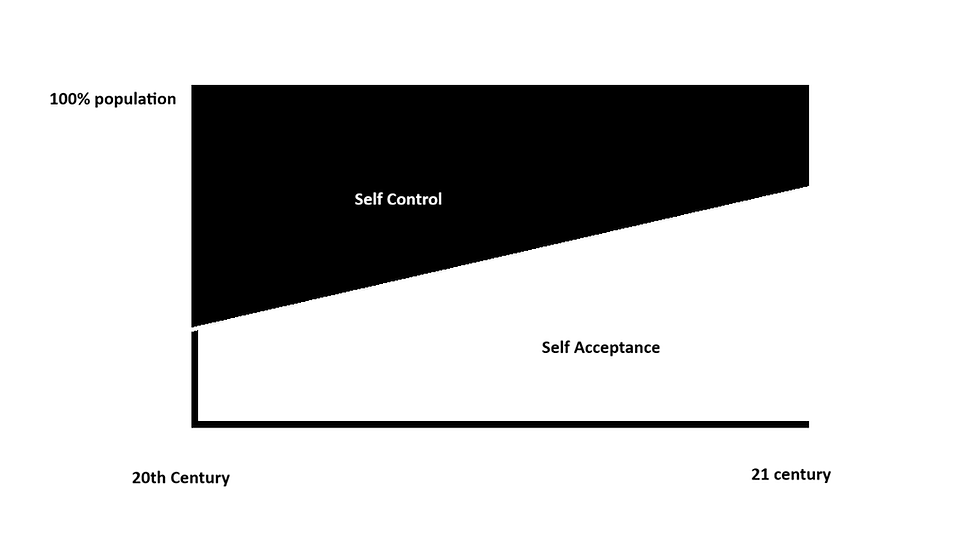
In the beginning of the century People were more focused on self-control. Which inherently agrees to the fact that we have a free will. But on the latter part, the deterministic views have become more popular that self-awareness and acceptance have become more popular. On the other hand, we can see, that this idea of self-acceptance was never zero at any point in time. If you go back in time in various eras, you will find philosophical quotes by different intellectuals came into these realizations. However, I would say that was not the popular view about the self, during early years of the last century.
"Most terrifying thing is to accept oneself completely" - Carl Jung.
Another, way to look at it is to see the chronological order of how things happen in an individual's life. First when kids start to learn, we plant a seed of self-control in their brains, so they do not back up when challenges are faces. We encourage them to take challenges, win or lose them. And teach how better tactics, better self-control will ultimately lead to success. It really does work for some time. Then the inevitable randomness of life, makes us meet with impossible challenges. Old age, disease, death are common challenges to any life. Sometimes, even unfair social disadvantages, where no matter how hard some try would not be able to overcome. Now, at this, the self-control is not going to work.
Evolution of self help in an individual -> self control - > self acceptance.
No matter how much we try we will not be able to "Cure cancer from meditation" or win an Olympic medal in high jump when you're born 4.5 feet tall. It is really impossible to fly into the sky on the edge without wings. In these places, we have to use the latter strategy which is self-acceptance. Self-acceptance that you are a better idiot than I am in writing, and I am better fool at things that you are good at. This happens naturally when people get old. Old grudges go away and everyone heads for the church, when they get old, including criminals and schoolmasters. Then the question of why not use it in the first place.

What if life is about failures, not wins. What if we chose to be failures in life, instead of chasing success. Will minimalism and mindfulness will bring bigger happiness than a pile of money? I would say that is a real possibility and achievable, as longer you observe mind, you realize that the reality is just a narrative of our own minds. So, now I have stopped hoping for a tomorrow without any problems. Life is inherently with its problems. If I chose living as an answer, I have to accept means as obvious problems of it, including death or cessation of this.
So, what have been your approach to self-help lately?


Similarly, there are contrasting perceptions of Christianity… fire and brimstone judgement vs merciful, “all sins can be forgiven”, unconditional love